TS 类型编程
现如今 TS 已经完全走进了前端社区,纵观流行的前端框架/库,都有 TS 类型支持,不少框架/库更是对于源码是使用 TypeScript 开发,完美支持 TypeScript 类型提示当作一大亮点去宣传。
在业务中用 TS 写写页面、表格等上层逻辑,基本就是把后端数据定义/转换成 interface,往后一把梭就完了,不需要对 TS 的类型系统有深入的了解。
但当封装公用组件/函数时,如果想封装的代码能够支持 TS 类型,就需要了解类型编程的一些技巧,本文就分享一些常用的类型编程技巧。
好的 TS 类型支持
良好的类型推断,避免重复的类型定义
// string[]
const result = [1, 2, 3]
  .map((item) => () => item)
  .map((fn) => ({ value: fn() }))
  .map((item) => ({ label: `${item.value}` }))
  .map((item) => item.label)

// ---
interface ResponseData {
  is_success: boolean
  data: {
    id: number
    pu_info: Record<string, string>
    service_price: number
    order_price: number
  }[]
}

const fetchListData = async () => {
  let data = await request<ResponseData>("/api/list") // ResponseData

  data = transformKeys(data) // ResponseData1: isSuccess puInfo orderPrice

  return transformMoney(data, ["orderPrice"]) // ResponseData2: orderPrice: string
}

const { data, isLoading, isError } = useSWR(fetchListData) // data: ResponseData2

const id = get(data, "data.id") // number
常见套路:提取 → 转换 → 重组 → 递归(循环)
前置知识
基础知识
// 类型
type T = string | number | boolean | class | interface // ...

// 类型推断
{
  let A = 1 // number
  let B = "hello" // string
  let C = [1, 2, 3] // number[]
}

// 常量类型推断
{
  const A = 1 // 1
  const B = "hello" // 'hello'
  const C = [1, 2, 3] as const // readonly [1, 2, 3]
}

// 联合类型:|
type Union = { hello: string } | { world: number }

// 交叉类型: &
type Intersect = { hello: string } & { world: number }

// .....
对象操作:keyof、in
// 返回对象 key 的常量联合类型
keyof T // hello | world

// 返回对象值的联合类型
T[keyof T] // string | number
T['hello'] // string
T['world'] // number

// in 操作符遍历联合类型
interface A {
    [K in string | number]: never
    [K in 'hello' | 'world']: never
    [K in keyof T]: T[K]
}

// ------ 源码 ------

/**
 * Make all properties in T required
 */
type Required<T> = {
    [P in keyof T]-?: T[P];
};

/**
 * From T, pick a set of properties whose keys are in the union K
 */
type Pick<T, K extends keyof T> = {
    [P in K]: T[P];
};

/**
 * Construct a type with a set of properties K of type T
 */
type Record<K extends keyof any, T> = {
    [P in K]: T;
}
类型约束、条件类型:extends
// 泛型参数约束
type T<P extends string> = {}

// 条件类型
type IsString<T> = T extends string ? true : false
type A = IsString<"1"> // true
type B = IsString<2> // false
条件类型推断:infer
- 声明一个类型
- 如果类型约束成功
- 将模式匹配后的类型分配给 1
// 条件类型推断
type Example<T> = T extends infer R ? R : never
type A = Example<"1"> // '1'
type B = Example<2> // 2
模式匹配
type A = [1, 2, 3]
type ExampleA = A extends [infer First, ...infer Rest] ? First : never // 1

type B = "123"
type ExampleB = B extends `${infer FirstChar}${infer Rest}` ? FirstChar : never // '1'

type C = (p: number) => string
type ExampleB = C extends (p: infer R) => any ? R : never // number

// ------ 源码(删减了类型约束) ------

/**
 * Obtain the parameters of a function type in a tuple
 */
type Parameters<T> = T extends (...args: infer P) => any ? P : never

/**
 * Obtain the return type of a function type
 */
type ReturnType<T> = T extends (...args: any) => infer R ? R : any

/**
 * Obtain the parameters of a constructor function type in a tuple
 */
type ConstructorParameters<T> = T extends abstract new (...args: infer P) => any
  ? P
  : never

/**
 * Obtain the return type of a constructor function type
 */
type InstanceType<T> = T extends abstract new (...args: any) => infer R
  ? R
  : any
函数参数泛型推导
function f<A, B, C extends string>(a: A, b: B, c: C) {}

f("a", "b" as const, "c") // function f<string, "b", "c">(): void

interface Api {
  "/api/phone": { phone: string }
  "/api/email": { email: string }
}

function request<T extends keyof Api>(url: T): Api[T] {
  return "" as any
}

request("/api/phone") // { phone: string }
request("/api/email") // { email: string }
示例
Get
Infer 在字符串模板中的小细节
- 如果模版中只有一个 infer,它会尽可能多的匹配(贪婪模式)。比如用 ${infer T}x 去匹配 'abcxxx',T 为 'abcxx'。
- 如果有多个 infer,最后一个 infer 是贪婪模式,前面的是非贪婪模式。比如 ${infer A}${infer B}${infer C} 去匹配 'abcdefg',结果为:A: 'a',B: 'b',C: 'cdefg'
type Get<T, Paths extends string> = Paths extends keyof T // 递归出口
  ? T[Paths]
  : Paths extends `${infer K}.${infer R}` // 匹配 . 语法
  ? K extends keyof T
    ? Get<T[K], R> // 递归
    : unknown
  : unknown

// _.get(obj, 'a.b.c')
type R = Get<{ a: { b: { c: { d: number } } } }, "a.b.c">
RTK Query
Api 设计
// @ts-nocheck
// Define a service using a base URL and expected endpoints
export const pokemonApi = createApi({
  endpoints: (builder) => ({
    getPokemonByName: builder.query<Pokemon[], string>({
      query: (name) => `pokemon/${name}`,
    }),
    getPokemonById: builder.query<Pokemon, string>({
      query: (id) => `pokemon/${id}`,
    }),
  }),
})

// Export hooks for usage in functional components, which are
// auto-generated based on the defined endpoints
export const { useGetPokemonByNameQuery, useGetPokemonByIdQuery } = pokemonApi

const { data, isLoading, isError } = useGetPokemonByNameQuery()
实现
interface Endpoints {
  getPokemonByName: string
  getPokemonById: number
}

// 转化 key 字符串
// 问题:无法取出准确的值类型
type _B = {
  [K in `use${Capitalize<keyof Endpoints>}Query`]: Endpoints[keyof Endpoints]
}

// 准确的值类型:双重遍历
// 问题:结构不是我们想要的
type B = {
  [P in keyof Endpoints]: {
    [K in `use${Capitalize<P>}Query`]: Endpoints[P]
  }
}

// 取出值类型
// 问题:联合类型,无法使用
type C = B[keyof B]

// 联合类型转交叉类型
type UnionToIntersect<T> = (T extends any ? (k: T) => any : never) extends (
  k: infer P
) => any
  ? P
  : never

type E = UnionToIntersect<C>

const e = {} as E

e.useGetPokemonByNameQuery // ✅
Redux
Api 设计
import { configureStore, createSlice, PayloadAction } from "@reduxjs/toolkit"

export const counterSlice = createSlice({
  name: "counter",
  initialState: {
    value: 0,
  },
  reducers: {
    increment: (state) => {
      state.value += 1
    },
    incrementByAmount: (state, action: PayloadAction<number>) => {
      state.value += action.payload
    },
  },
})

export default configureStore({
  reducer: {
    counter: counterSlice.reducer,
  },
})

// @ts-ignore
dispatch({ type: "counter/incrementByAmount", payload: 1 })
实现:略
TransformKeys
interface ResponseData {
  is_success: boolean
  data: {
    id: number
    pu_info: Record<string, string>
    service_price: number
    order_price: number
  }[]
}

// 下划线转驼峰
type Camelize<
  S extends string,
  V extends string = ""
> = S extends `${infer A}_${infer B}${infer C}`
  ? Camelize<C, `${V}${A}${Capitalize<B>}`>
  : `${V}${S}`

type A = Camelize<"hello_java_script">

// 工具函数:取出 Value 的类型
type ValueType<T> = T[keyof T]

// 联合转交叉
type UnionToIntersect<T> = (T extends any ? (k: T) => any : never) extends (
  k: infer P
) => any
  ? P
  : never

// 转换 keys
type TransformKeys<T> = UnionToIntersect<
  ValueType<{
    [K in keyof T]: K extends string
      ? {
          [P in `${Camelize<K>}`]: T[K] extends any[]
            ? Array<TransformKeys<T[K][0]>>
            : T[K] extends Record<string, any>
            ? TransformKeys<T[K]>
            : T[K]
        }
      : never
  }>
>

type R1 = TransformKeys<ResponseData>

const a = {} as R1

a.data[0].id
TransformMoney
transformMoney(data, ["orderPrice"]) // ResponseData2: orderPrice: string

// 元祖转联合
type A = ["A", "B"]

type B = A[number] // A | B

// ---

interface Data {
  id: number
  servicePrice: number
  orderPrice: number
}

// 转换 keys
type Transform<T, Keys> = {
  [K in keyof T]: K extends Keys ? string : T[K]
}

type R = Transform<Data, "orderPrice">
扩展知识
字符串类型处理
/**
 * Convert string literal type to uppercase
 */
type Uppercase<S extends string> = intrinsic

/**
 * Convert string literal type to lowercase
 */
type Lowercase<S extends string> = intrinsic

/**
 * Convert first character of string literal type to uppercase
 */
type Capitalize<S extends string> = intrinsic

/**
 * Convert first character of string literal type to lowercase
 */
type Uncapitalize<S extends string> = intrinsic
联合类型转交叉类型
函数参数逆变 + 分配条件类型
// 类型推断时,在逆变位置的同一类型变量中的多个候选会被推断成交叉类型(函数签名重载的参数位置类型会被推断为交叉类型)
// https://github.com/Microsoft/TypeScript/pull/21496
type Func = ((arg: { a: string }) => void) | ((arg: { b: number }) => void)
type U = Func extends (arg: infer A) => any ? A : never // { a: string } & { b: number }

// {a: string} | {b: number} 如何变为函数签名重载?

// 分配条件类型
// 官网:当泛型类型是联合类型时,条件判断会变得具有分配性
// 人话:extends 左边的范型联合类型,会拆开分别处理
type ToArray<Type> = Type extends any ? Type[] : never
type StrArrOrNumArr = ToArray<string | number> // string[] | number[] 而非是 (string | number)[]
逆变、协变
类型系统中的概念,表达父子类型关系
TS 中参数位置是逆变的,返回值是协变的
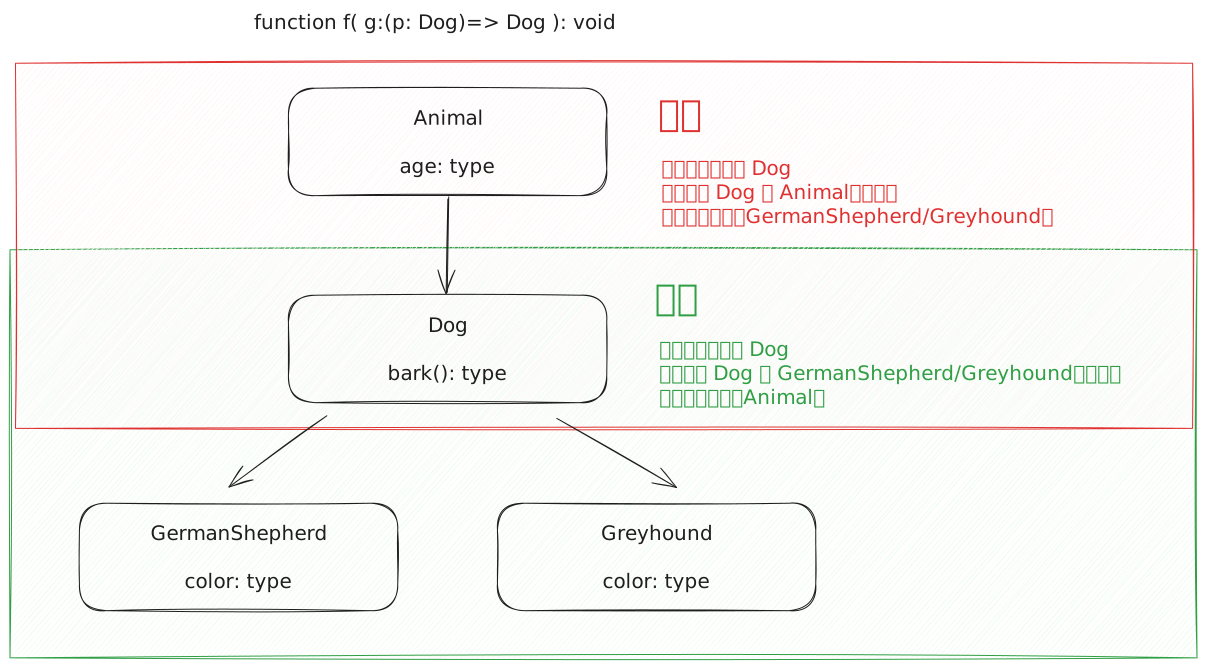
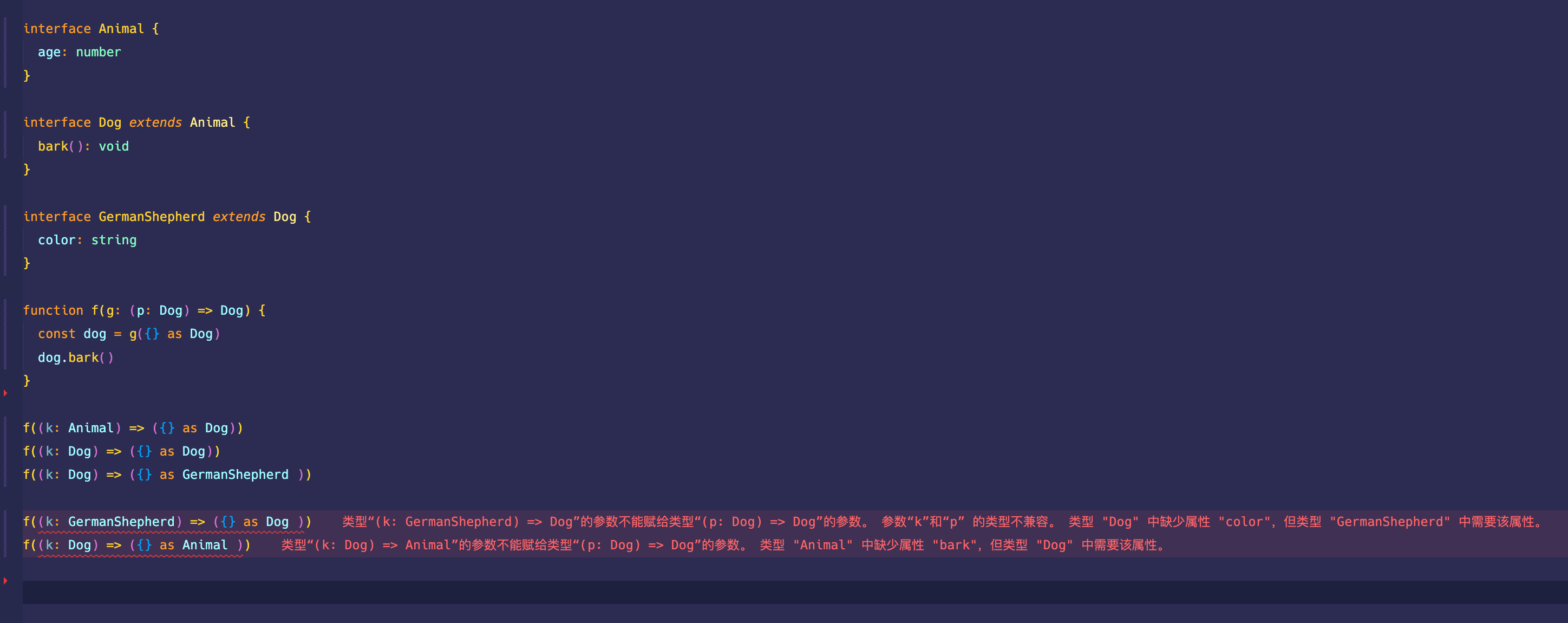
https://github.com/sl1673495/blogs/issues/54
https://jkchao.github.io/typescript-book-chinese/tips/covarianceAndContravariance.html
元祖转联合
type A = ["A", "B"]

type B = A[number]
类型体操
- 条件判断:
T extends string ? T : never - 循环: 递归
- 运算: 数组长度
- 变量: 泛型、infer
- 数据结构
觉得有帮助?给个 Star 支持一下吧!
Star on GitHub